
Understanding The Humans In Your Organization
One of the most important things to understand in management is that what people say about their motivation is only half true. They say they want success for the team or project or organization…and it’s true they do want that. However, what they won’t say is that they also have a strong personal agenda, and […]

Making a Case to Management: Why Building a Culture of Wellness is a Win-Win for Employees and Employers
HR professionals do their best as facilitators in helping employers realize the importance of addressing employees’ mental and physical health issues arising from the workplace. However, it can often be an uphill battle for HR to convince upper management to invest in employee wellness. You’re likely to come across someone in your social circle or […]

The Emotionally Strong Leader: Transforming Leadership from Within
In the ever-evolving landscape of leadership, one enduring trait stands out: emotional intelligence. It is the cornerstone that enables leaders to navigate the intricate realm of human emotions with strength, empathy, and wisdom, propelling teams toward shared goals. Contrary to popular belief, being emotionally strong does not entail suppressing feelings or maintaining an unwavering resolve […]

Unlocking the Full Potential of Employee Surveys: Common Mistakes You Might Be Making
Picture it — you’ve just gotten your coffee, plopped down into your office chair, and you’re ready to work for the day as the manager or a leader of an organization. Your team is hard at work, plugging away at the projects and tasks assigned to them, and everything seems pretty status quo. However, you […]

Research Says Women In The Workplace Are Twice As Worse-off Financially Compared To Male Counterparts
An overwhelming 40% of female professionals feel underpaid for what they do – with a tenth of women in white-collar roles resorting to additional means of income such as credit cards, or weekend jobs. The findings – from international recruitment consultancy Robert Walters – comes ahead of International Women’s Day and reveals that just 39% […]

How Building a Strong Purpose-Driven Culture Boosts Employee Engagement
One of the key mandates for HR leaders and organizations worldwide is developing and maintaining an engaged workforce and a robust corporate culture. These two things are inextricably intertwined and difficult to build. Ignore one, and you cannot achieve the other. Without a strong culture, an organization will struggle to achieve its goals. Especially in […]
HR Law
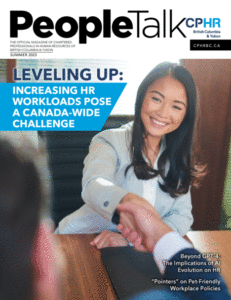
“Pointers” On Pet-Friendly Workplace Policies - J. Geoffrey Howard, CPHR
Navigating AI in the Workplace: Policy-Drafting for the Inevitable - Michela Fiorido and Suzanne Kennedy
Leadership & Growth
Understanding The Humans In Your Organization - David Creelman
The Future Of Work
A Fresh Perspective from Mintzberg - David Creelman
The End of Personality Assessments? - David Creelman
Workplace Wellness
Making a Case to Management: Why Building a Culture of Wellness is a Win-Win for Employees and Employers - Michelle Rene Divecha
Mental Toughness and Mental Health - David Creelman
Membership

Job Board

PeopleTalk
Chartered Professionals in Human Resources of British Columbia & Yukon
1101-1111 West Hastings St. | Vancouver, BC | V6E 2J3
tel. 604.684.7228 | toll free. 800.665.1961 | email. info@cphrbc.ca | web: cphrbc.ca
© 2024 Chartered Professionals in Human Resources of British Columbia & Yukon
1101-1111 West Hastings St. | Vancouver, BC | V6E 2J3
tel. 604.684.7228 | toll free. 800.665.1961 | email. info@cphrbc.ca | web: cphrbc.ca
© 2024 Chartered Professionals in Human Resources of British Columbia & Yukon